
How to Greet a Muslim: Islamic & Arabic Greetings Explained with Respect
Knowing how to greet a Muslim warmly and correctly is one of the simplest ways to build trust, show respect, and open doors - whether you're meeting a colleague, visiting a family for the first time, or exploring a relationship that could change your life. This guide walks you through the most important islamic greetings, their meaning, correct pronunciation, and the etiquette that turns a simple phrase into a bridge between hearts.
Key Takeaways
The most common greeting among Muslims worldwide is as salamu alaykum (السلام عليكم), which means "Peace be upon you." The response is wa alaykumu s-salam (وعليكم السلام), meaning "And peace be upon you too."
Both Muslims and non Muslim people may use this greeting respectfully - it is not restricted to Arabs or the arabic language.
Time-based greetings like sabah al khair (صباح الخير) for good morning and masa al khair (مساء الخير) for good evening are common arabic greetings used across arabic speaking countries.
Phrases like ahlan wa sahlan (أهلاً وسهلاً) and marhaba (مرحبا) help you greet people warmly in different cultures and settings.
Learning a handful of these expressions builds trust in sensitive contexts like relationships, marriage, and family gatherings.
What Is the Main Islamic Greeting and How to Use It Immediately

If you've ever heard a Muslim say as salamu alaykum, you've heard the single most common greeting in the muslim world. As-salamu alaykum means "Peace be upon you," and it is used by over 1.9 billion Muslims across every continent - from Jakarta to Toronto, in homes, mosques, offices, and online chats. This greeting expresses goodwill, peace, and community ties in a way that no casual "hey" ever could.
The correct response is wa alaykumu s-salam, which literally translates to "And peace be upon you too." Returning the greeting is considered wajib (obligatory) by many scholars, based on the Qur'anic command:
"And when you are greeted with a greeting, greet in return with what is better than it or (at least) return it equally." (An-Nisāʾ 4:86)
For extra respect - especially in khutbahs, nikah ceremonies, or meeting elders - Muslims often extend the phrase to its full form: as-salamu alaykum wa rahmatullahi wa barakatuh (السلام عليكم ورحمة الله وبركاته), meaning "Peace be upon you, and the mercy of Allah and His blessings." The complete greeting is as-salamu alaykum wa rahmatullahi wa barakatuh, and the full Muslim greeting includes blessings from Allah, making it a supplication for the person you are addressing.
The spiritual weight of this salam is captured in a hadith from Ṣaḥīḥ Muslim (Book of Faith, Hadith 54):
"You will not enter Paradise until you believe, and you will not believe until you love one another. Shall I tell you of something which, if you do it, you will love one another? Spread the greeting of peace among yourselves."
This practice is rooted in Qur'an 24:61: "When you enter houses, greet one another with a greeting from Allah, blessed and good." It is sunnah to initiate salam, and the greeting functions as a duʿā - you are literally asking for Allah's peace to descend on the other person.
Real-life example: Imagine a 2026 London workplace where a non-Muslim employee finishes a morning meeting, sees her Muslim colleague returning from prayer, and says "as-salāmu ʿalaykum" with a genuine smile. That small act of respect is commonly heard in modern interfaith offices and is almost always appreciated. At FindLoveIA, the same spirit of peace and mercy shapes how we guide Muslim singles - you can explore our mission and programs to see this in action.
Islamic Etiquette: Who to Greet First and How (Adab of Salām)
Islamic greetings are not only words - they are manners (adab) that protect hearts, especially in relationships and marriage. The Prophet Muhammad ﷺ gave specific guidance on who should initiate the greeting, as recorded in Sahih al-Bukhari 6232:
"The one who is riding should greet the one who is walking, and the one walking should greet the one who is sitting, and the small group greets the larger group."
Younger people are encouraged to start the greeting with elders - a practice that remains central in many Muslim families across different cultures. When you use the right hand to shake hands or hand something to someone, you also follow Islamic etiquette, which values intentionality in every gesture.
Gender interaction: In most conservative Muslim communities, men avoid handshakes or hugs with unrelated women and vice versa. A verbal salam and a gentle, respectful smile are sufficient. This is not coldness; it is ḥayā (modesty).
Practical scenarios:
Meeting future in-laws: Use the full form - "as-salāmu ʿalaykum wa raḥmatullāhi wa barakātuh, it is an honor to meet you." Speak calmly, maintain modest body language.
Greeting an imam: Full greeting, sometimes preceded by an honorific: "Shaykh Ahmad, as-salāmu ʿalaykum wa raḥmatullāhi wa barakātuh."
A structured meeting with someone you might date a single Muslim seriously: Begin with salam in the presence of a chaperone. It sets the tone of respect immediately.
Scholars differ about starting salam with non Muslims. Many allow it in contexts of outreach, work, and neighbourliness, while some recommend neutral greetings like "good morning" plus a warm smile. Both perspectives are documented in classical and contemporary fiqh discussions.
Online greetings: Starting messages with "as-salāmu ʿalaykum" in chats, nikah proposals, or through a Muslim matchmaking program sets a tone of safety and respect from the very first message.
Common Arabic & Islamic Greetings to Master

Even without arabic fluency, learning a few common arabic and islamic greetings is a gentle first step for anyone exploring love, marriage, or travel in the arab world. Arabic greetings reflect cultural respect and hospitality - each phrase carries a meaning shaped by centuries of use among arabic speakers.
As-salāmu ʿalaykum (السلام عليكم)
The core islamic greeting used by Muslims of every ethnicity - from Indonesia to Canada - not limited to the arab community.
Suitable any time of day: greet friends, family, a spouse, potential spouse, imams, or colleagues.
It is a duʿā: you are asking for Allah's peace to descend on the other person, making it a beautiful conversation starter for sensitive topics like love or marriage.
The reply "wa ʿalaykumu s-salām" must be at least equal; the recommended form is "wa ʿalaykumu s-salām wa raḥmatullāhi wa barakātuh."
Ahlan wa sahlan (أهلاً وسهلاً)
Means "Welcome and feel at ease" - used across the arab world when hosting guests or welcoming new in-laws.
Warm and hospitable, suitable for both Muslims and non Muslims at homes, study circles, and wedding events.
Used with a name for emotional intimacy: "Ahlan wa sahlan yā Layla."
Reduces anxiety for singles meeting through a matchmaking platform for the first time.
Marḥaban / Marḥabā (مرحبا)
Marhaba translates to "Hello" or "Welcome" - common in the Levant, Gulf, and North Africa.
Can be combined with islamic greetings: "as-salāmu ʿalaykum, marḥabā!" to add warmth.
Safe to use with non Muslim people in mixed social or professional spaces without sounding too formal.
Great for greeting guests at a Mehndi ceremony, welcoming muslim friends to an Eid open house, or starting casual conversations on a video call.
Ṣabāḥ al-khair (صباح الخير) – Good Morning
Sabah al-khayr means "Good morning" - the standard arabic morning greeting from Cairo cafés to Dubai offices.
The reply is sabah al noor (صباح النور), meaning "morning of light," a playful exchange that strengthens affection in married life.
Example text message between spouses: "ṣabāḥ al-khair ḥabībtī 💛" - simple, warm, and consistent with faith.
Non-Arabs can pronounce it after a bit of practice; it is a gentle first step toward learning arabic.
Masāʾ al-khair (مساء الخير) – Good Evening
Masa' al-khayr means "Good evening" - the go-to greeting from late afternoon until nightfall in many arab countries.
The reply is masa al noor (مساء النور), meaning "evening of light." Couples often use it when reconnecting after work.
Non Muslims visiting Muslim-majority cities can combine it with salam for extra politeness: "masāʾ al-khair, as-salāmu ʿalaykum."
Useful in more formal settings like premarital counseling sessions or relationship workshops scheduled in the evening.
Salām / Salām! (سلام)
The shorter form simply means peace - more casual than the full islamic greeting, perfect for quick hellos.
Young people might message "Salām, how are you?" in chats, especially in mixed-language casual conversations.
In formal settings, always use the full "as-salāmu ʿalaykum" rather than just "Salām."
Imagine someone shifting from "hi" to "Salām" as they grow more comfortable with Islamic culture - that small change speaks volumes about respect and sincerity.
Greeting Muslims Respectfully as a Non-Muslim
Many non Muslim people want to acknowledge and honour their muslim friends, colleagues, or potential partners but feel unsure about what is appropriate. The good news: most Muslims appreciate it when a non-Muslim says "as-salāmu ʿalaykum" sincerely, without mocking or trivializing the phrase. It is a sign you have heard the greeting, understand its meaning, and want to meet the other person on their terms.
Scholars hold differing views on whether Muslims should initiate salam with non Muslims, but there is wide agreement that replying to a kind greeting and showing neighbourliness is encouraged in islam.
A simple step-by-step for a non-Muslim:
Start with a smile.
Say "as-salāmu ʿalaykum" or "good morning" - either is fine and respectful.
Respect boundaries around physical touch (do not assume a handshake, especially with the opposite sex).
Maintain modest, open body language.
In a 2026 workplace, respect prayer times: do not interrupt during ṣalāh, but greet with salam when your colleague finishes. If you are exploring marriage with a Muslim, learning islamic greetings and a few common arabic phrases in standard arabic shows seriousness and respect for both faith and family. Our article on Islamic marriage principles at Muslim Law About Marriage helps non-Muslim partners understand the spiritual framework behind these greetings and boundaries.
How Islamic Greetings Nourish Love, Family & Marriage
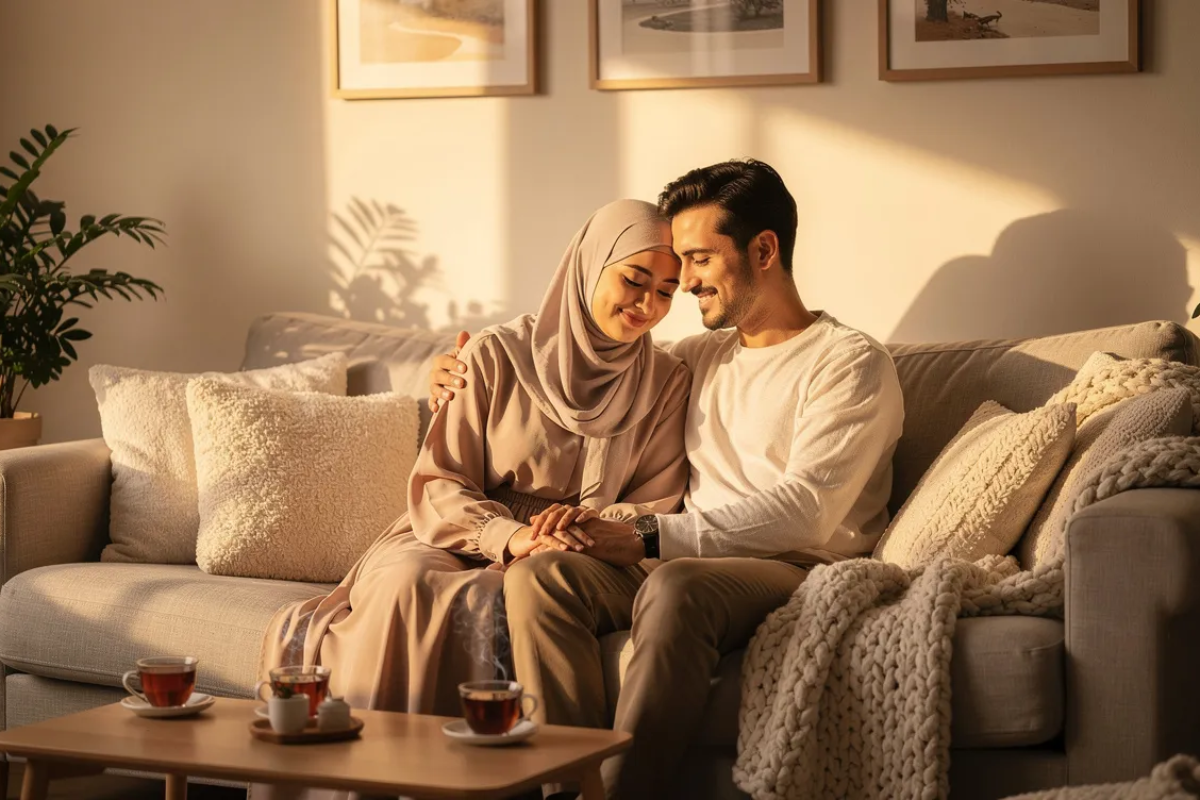
Understanding how to greet muslim loved ones is not just etiquette - it is the beginning of emotional safety. Verbalizing prayers for others fosters love and unity within the community, and nowhere is this more true than at home.
The Prophet Muhammad ﷺ said: "Spread salām among yourselves" (Sahih Muslim 54). Apply this to everyday married life: walking into the home, reconnecting after conflict, or simply starting the day. Couples can use "ṣabāḥ al-khair," "masāʾ al-khair," and "as-salāmu ʿalaykum" consciously to reset tension and invite mercy after disagreements.
Family rituals: Greet children with salam when they enter the house. Teach them to reply "wa ʿalaykumu s-salām" by age 3–4. This ties language to identity and belonging. During major holidays, it is common to say "Eid Mubarak" or "Ramadan Mubarak" - greetings like these carry well wishes that anchor family traditions. Another phrase worth knowing is Jazakum Allahu Khayran, which translates to "May Allah reward you with goodness" and is used to express gratitude within families and communities.
FindLoveIA's Love, InshaAllah content and Islamic quotes about love article both show how words of peace, duʿā, and mercy soften hearts before difficult conversations. A couple sitting down to discuss finances or boundaries might begin with "as-salāmu ʿalaykum" - that single phrase changes the tone of the entire conversation from adversarial to collaborative.
Learning Arabic Greetings as a Gateway to Deeper Understanding
Even learning 10–15 common arabic expressions can transform how you connect with Muslim communities worldwide. Arabic is the language of the quran, so phrases like as-salāmu ʿalaykum resonate spiritually for believers in a way that "hi" simply does not. Saying Bismillah, which means "In the name of Allah," before starting something important is another phrase that carries deep significance in daily life.
Where to start: Begin with greetings and duas, then move to simple sentences. Use 2026 online resources, tutors, or apps, but always verify religious phrases with reliable scholars. For those seriously considering marriage with a Muslim, learning core islamic greetings and Islamic terms shows commitment to understanding your partner's world, god willing.
Integrate arabic greetings into text messages, voice notes, and wedding invitations alongside local languages. This honours both culture and deen - and it is more fun than you might expect. You don't need to master arabic overnight; even a correct "as-salāmu ʿalaykum" spoken with sincerity leaves a lasting impression.
FAQs
Is it okay for a non-Muslim to say "as-salāmu ʿalaykum"?
Most Muslims are happy when non-Muslims use this Islamic greeting respectfully. It means "Peace be upon you" and carries genuine goodwill. In 2026 interfaith workplaces from New York to Dubai, colleagues commonly say as salamu alaykum and wa alaykumu s-salam during daily interactions. Treat the phrase with the same respect you would give "Shalom" or "Namaste"—as something sacred to that community. Avoid joking or sarcastic tones, and you will not be offended or cause offense.
How should I greet a Muslim of the opposite sex?
The safest default is a verbal greeting such as "as-salāmu ʿalaykum" or "good morning" accompanied by a polite smile, without expecting a handshake. Many observant Muslims—both men and women—do not shake hands with unrelated members of the opposite sex, including colleagues they do not know well. A simple "As-salāmu ʿalaykum, it is nice to meet you" while keeping a respectful distance works well in both professional and personal contexts. If it is the first time meeting someone, let them guide the level of contact.
What if I mispronounce "as-salāmu ʿalaykum" or other Arabic greetings?
Intention matters most. If the meaning is clear and you are being respectful, minor pronunciation mistakes are forgiven. A simple phonetic guide is "as-sa-LA-mu a-LAY-kum." Practicing with a Muslim friend or listening to native Arabic speakers on reputable Islamic channels can help. Your effort to learn the correct phrase is itself a comment on your character—it speaks louder than perfect pronunciation ever could.
Can I just say "good morning" or "hello" instead of Arabic phrases?
Absolutely. It is perfectly fine to greet Muslims in your own language with "good morning," "good evening," or "hello." Many Muslims appreciate when people combine both greetings, such as saying "Good morning, as-salāmu ʿalaykum," because it bridges cultures gracefully. Phrases like masa al khair and sabah al khair are easy additions once you start with the basics. Of course, any respectful greeting is better than silence.
What is the difference between "Salām," "as-salāmu ʿalaykum," and "Shalom"?
Salām (سلام) in Arabic and Shalom in Hebrew share the same Semitic root meaning peace. As-salāmu ʿalaykum literally translates to "Peace be upon you" and is the formal Islamic greeting rooted in the Qur’an and Sunnah. "Shalom" is a Jewish greeting, while "Salām" alone is a shortened, casual Arabic hello commonly used in everyday life. It is important to use each phrase within its correct context, especially when building interfaith relationships or considering a long-term partnership rooted in shared respect and faith.