
Christian and Muslim Relationships: Faith, Love, and Practical Guidance
A christian and muslim relationship can be sincere, loving, and respectful, but it is rarely simple. Faith affects worship, family, law, children, and the meaning of marriage itself. This guide gives a clear answer without panic, pressure, or pretending the differences do not matter.
Key Takeaways
Christian–Muslim relationships are possible, but they require honesty about theology, family expectations, and legal rules in islam and christianity. Couples need more than chemistry; they need clarity before turning a relationship into a marriage relationship.
Muslims and Christians share belief in one god, revelation, prayer, charity, fasting, modesty, moral accountability, heaven, hell, and a final Day of Judgment.
They differ deeply on jesus christ, the Trinity, the holy spirit, salvation, crucifixion, resurrection, and eternal life.
A muslim man, muslim woman, christian man, and christian woman each face different religious rules around interfaith marriage in classical Islamic law and common Christian teaching.
Couples should discuss conversion, children’s religion, worship, holidays, and extended family before deciding to marry a muslim or christian partner.
FindLoveIA resources such as Love, InshaAllah and our mission and programs help couples approach love with clarity, taqwa, and emotional maturity.
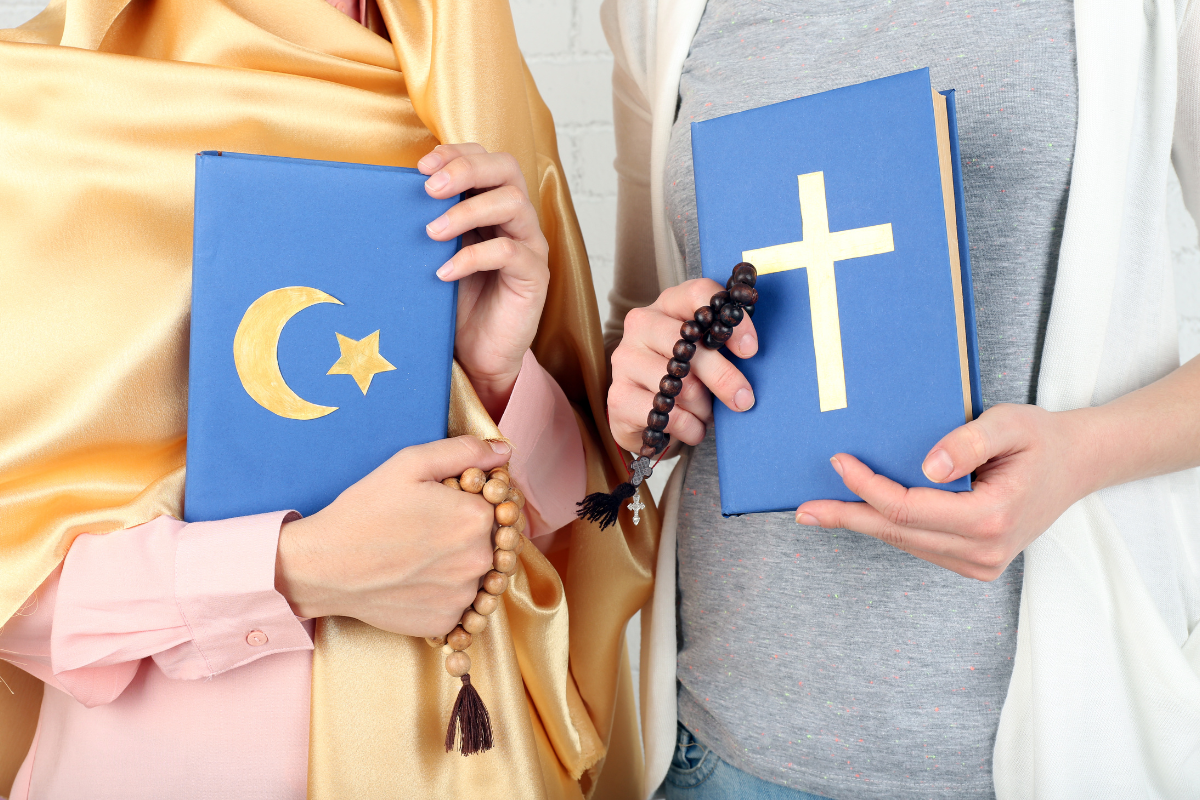
1. Shared Roots: What Christians and Muslims Have in Common
Christianity began in the 1st century CE, while Islam originated in the 7th century in the Arabian Peninsula. Muhammad received revelations from 609 to 632 CE, and the Quran was revealed to Muhammad over 23 years. Christianity and Islam are the world’s two largest monotheistic faiths, and both traditions trace their spiritual lineage back to the prophet Abraham.
Both faiths believe in one God, the creator of the universe. Both Christianity and Islam utilize holy books and emphasize ethical living; the Christian Bible includes the Old and New Testaments, while Muslims follow the quran as final revelation. Both traditions believe in angels, including Gabriel, prophets such as Abraham, Moses, and Jesus, and both religions believe in the Second Coming of Jesus.
Christians see Jesus as Son of God, Savior, lord, christ, and the only son of the Father. Muslims believe Jesus was a prophet, not the Son of God; in islamic tradition, ‘Isa ibn Maryam is the Messiah, born to Maryam by God’s command. Many muslims deeply honor Mary and Jesus, even while rejecting Christian claims about divinity.
Both religions place importance on prayer, charity, fasting, and modesty. Their scriptures call believers to honesty, family responsibility, justice, and mercy. The Quran encourages justice and kindness towards non-Muslims, and islam teaches to treat others fairly regardless of their faith.
Historically, Islam began with early Muslims finding refuge in Christian Abyssinia. Waraqah ibn Nawfal was a Christian priest who supported Muhammad. The Prophet Muhammad maintained good relations with Christians, although later history included tension: the rapid expansion of the Islamic empire absorbed many Christian lands across the Arab world, north africa, and beyond. In 746, John of Damascus criticized the Quran in his writings.
There were also periods of convivencia, when Muslims, Christians, and Jews exchanged ideas. Today’s Christian-Muslim relations are marked by mistrust and collaboration. Historical and geopolitical tensions fuel mutual distrust between communities, but engaging in dialogue can help build knowledge and dismantle ignorance. Collaborating on community projects builds trust between Christians and Muslims, because coexistence is based on humanity despite religious differences.
2. Core Theological Differences: God, Jesus, and the Holy Spirit
Successful Christian and Muslim relationships require more than shared values. Not everyone realizes how much theology shapes daily life, parenting, and worship.
Key Beliefs Compared
The Trinity vs. Tawhid: Christians believe in the Trinity (Father, Son, Holy Spirit) as one God (Matthew 28:19), while Islam teaches Tawhid, emphasizing God's absolute oneness without partners (Qur’an 112:1–4).
Jesus' Nature and Role: Christians see Jesus as the Son of God who died and rose again (1 Corinthians 15:3–4). Muslims believe Jesus was not crucified but raised by God (Qur’an 4:157–158).
The Holy Spirit: Christians view the Holy Spirit as God; Muslims interpret it as the angel Gabriel (Qur’an 16:102).
These theological differences influence how each partner practices worship, understands prayer, and approaches spiritual life.
3. Islamic Law on Interfaith Marriage
Classical Islamic jurisprudence differentiates between Muslim men and women regarding marriage to non-Muslims, especially People of the Book. For detailed guidance, see Muslim Law About Marriage.
Rules and Conditions
Muslim Men: May marry chaste Christian or Jewish women (Qur’an 5:5), with conditions such as valid nikah, fairness, consent, protection of her faith, and Muslim upbringing for children.
Muslim Women: Generally prohibited from marrying non-Muslim men unless the man converts to Islam (Qur’an 2:221, 60:10).
Challenges: Religious upbringing of children can be complex, requiring open discussion on madrasa, church life, and family expectations.
Modern minority opinions exist but remain uncommon. Consult local scholars before proceeding.
4. Christian Teaching on Marrying a Muslim
Christian teaching varies widely. Many churches advise caution based on scriptures like 2 Corinthians 6:14 about being "unequally yoked."
Perspectives
Biblical Guidance: Emphasizes marrying within the faith to strengthen discipleship (1 Corinthians 7:12–16, 7:39).
Catholic View: Allows "disparity of cult" marriages with dispensation, requiring promises to raise children Catholic.
Ecumenical Recognition: The Second Vatican Council acknowledged Muslims as worshiping one God (Nostra aetate, 1964).
5. Everyday Life in a Christian–Muslim Relationship
Daily life involves navigating worship, diet, holidays, and children’s upbringing.
Practical Considerations
Prayer: Muslim spouse may pray five times daily; Christian spouse attends church and personal prayer.
Food: Halal dietary laws affect meals; mutual respect is essential.
Holidays: Celebrate Ramadan, Eid, Christmas, Easter with sensitivity.
Children: Decide on religious education, naming, and rituals in advance.
For personal stories, see Dating a Muslim Man.
6. Risks, Red Flags, and When Not to Marry
Love is powerful but does not erase religious differences.
Warning Signs
Pressure to convert quickly
Hiding the relationship
Inconsistent religious practice
Refusal to discuss children’s faith
Treating religion as irrelevant
Legal and social risks exist, especially in Muslim-majority countries. Seek advice from religious leaders and counselors.

7. Building Healthy Christian–Muslim Relationships
FindLoveIA helps Muslims honor Allah in love and marriage while addressing complex realities through a Muslim matchmaking program.
Whether continuing or ending a relationship, seek Allah’s guidance through du‘a, istikhara, Qur’an, Sunnah, family wisdom, and scholarly counsel. Emotional maturity and knowledge lead to peace.
FAQs
Is it permissible in Islam for me as a Muslim woman to marry a Christian man I love?
The mainstream Islamic view is that a muslim woman may not marry a non muslim man, including a christian man, unless he sincerely accepts Islam. Qur’an 2:221 says, “And do not marry polytheistic men [to your women] until they believe,” and Qur’an 60:10 says, “They are not lawful [wives] for them, nor are they lawful [husbands] for them.” Emotional attachment alone does not override clear religious teaching. Speak to a trusted scholar, a wise family member, and pray Salat al-Istikhara while protecting your dignity and safety.
Can a Christian and Muslim couple agree to raise children in both faiths?
From an Islamic perspective, most scholars hold that children of a Muslim should be raised Muslim, learning shahada, salat, Quran, and basic beliefs. Many churches also hope children will be baptized, catechized, and brought into church life. Saying “both religions” sounds peaceful, but it is not necessarily practical when doctrines conflict. Discuss naming, circumcision, baptism, ‘aqiqa, school, and holidays before engagement.
How can we keep mutual respect if we disagree about Jesus and the Holy Spirit?
Set clear boundaries: no mocking, no insults, and no debates during arguments. Acknowledge openly that Christians worship Jesus as divine while Muslims honor Jesus as prophet and Messiah. Focus on mercy, honesty, service to the poor, and family loyalty. The Muslim partner can read the Gospels, and the Christian partner can read an accurate Quran translation, asking to understand rather than win.
What if my family refuses to accept my Christian or Muslim partner?
Move slowly and avoid ultimatums. A Muslim family may fear loss of faith, while a Christian family may fear cultural or religious conflict. Use respected elders, calm introductions, and honest explanations. In Islam, pleasing parents is important but not above obedience to Allah; in Christianity, honoring father and mother in Exodus 20:12 is balanced with following Christ, even when family disagrees, as Luke 14:26 is often understood.
How do I know if I should end my Christian–Muslim relationship?
Ask direct questions: Are you drifting from prayer, Quran, Bible, church, or the mosque? Do you feel constant pressure to change core beliefs? Are you hiding your faith from your partner? If the answer is yes, seek counsel from an imam or pastor who understands interfaith issues. Ending a relationship can be painful, but it may protect your faith, future children, and long-term well-being.